Cleanliness Testing Solutions for Hydraulic & Pneumatic System
Industry Overview: Why Component Cleanliness Matters in Hydraulic & Pneumatic System
Hydraulic and pneumatic systems are widely used in industrial automation, mobile machinery, manufacturing equipment, material handling, construction machinery, and precision motion systems. Their reliability depends not only on component design and assembly quality, but also on controlling particulate contamination.
In hydraulic systems, components such as valve blocks, hydraulic valves, pumps, cylinders, manifolds, and precision control elements operate with close clearances and pressurized fluids. Particles introduced during machining, assembly, or maintenance can contribute to wear, valve malfunction, leakage, or reduced system reliability.
Pneumatic systems also require controlled air quality. Particles, oil, and water in compressed air can affect valves, actuators, filters, and other pneumatic components.
For component manufacturers and system suppliers, hydraulic component cleanliness testing and contamination control provide measurable information for evaluating manufacturing cleanliness and improving process quality.
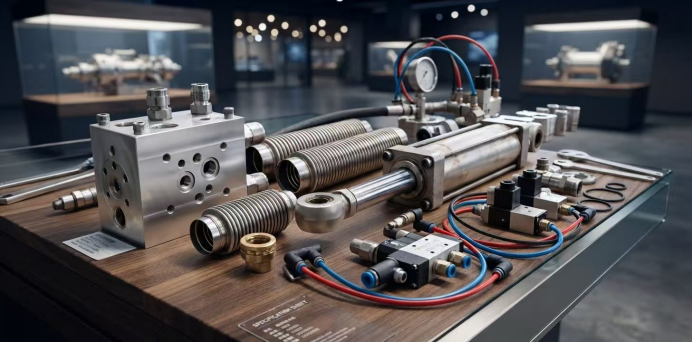
Applicable Hydraulic and Pneumatic Components
Cleanliness inspection can be applied to a wide range of hydraulic components and selected pneumatic components, depending on their function and customer requirements.
Hydraulic components
l Hydraulic valve bodies and valve blocks
l Hydraulic manifolds and control blocks
l Pumps and motor housings
l Hydraulic cylinders and precision actuators
l Hydraulic fittings and fluid connectors
l Precision machined hydraulic components
l Components with internal passages, cavities, and drilled channels
These components may contain particles generated during drilling, milling, turning, grinding, deburring, casting, or assembly.
Pneumatic components
l Pneumatic valve bodies
l Air preparation components
l Pneumatic manifolds
l Cylinders and actuators
l Precision air control components
l Pneumatic fittings and connectors
For pneumatic applications, cleanliness requirements should be considered together with the specified compressed-air quality and the functional requirements of the component.
For components with narrow internal passages, blind holes, and complex cavities, an appropriate extraction method may be required to obtain representative information about particulate contamination.
Common Sources of Particle Contamination
Particle contamination in hydraulic and pneumatic components can originate from several manufacturing and handling processes.
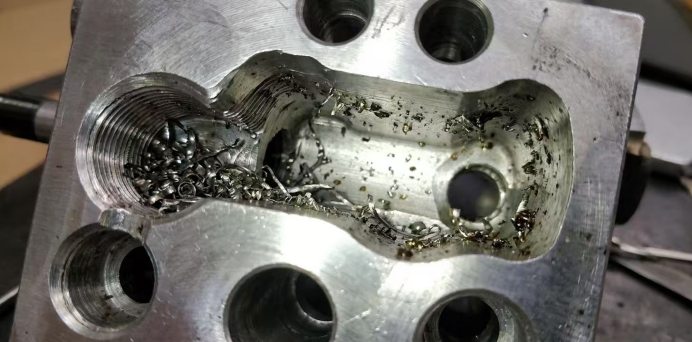
Machining: Drilling, milling, turning, grinding, and cutting can generate metal chips, burrs, and fine machining residues. Internal channels and blind holes can make these contaminants difficult to remove.
Deburring and finishing: Incomplete deburring or inadequate cleaning after finishing operations may leave particles attached to internal surfaces.
Casting and forming: Sand, scale, oxide particles, and other process residues may remain after casting, forging, or forming.
Assembly and handling: Particles can also be introduced during assembly through tools, fixtures, packaging materials, gloves, or the surrounding production environment.
Maintenance and installation: Hydraulic and pneumatic systems may be exposed to contamination during hose connection, component replacement, fluid filling, or system maintenance.
Why Component Cleanliness Testing Is Necessary
Hydraulic and pneumatic components often contain internal channels, cavities, blind holes, and precision-machined surfaces that are difficult to inspect directly. During drilling, milling, turning, grinding, deburring, cleaning, and assembly, particles such as metal chips, burrs, machining residues, and fibers may remain on or inside the component.
For components used in precision fluid power systems, these particles can become a source of contamination after installation. Once released during operation, they may enter sensitive areas of the system and potentially affect valves, pumps, actuators, control elements, or other precision components.
This is particularly important for hydraulic valve blocks, manifolds, pump and motor housings, fittings, cylinders, and other precision-machined components with complex internal passages.
Visual inspection alone is often insufficient because critical surfaces may be located inside channels or cavities that cannot be accessed directly. Technical cleanliness testing provides a more objective way to extract and quantify particulate contamination from these areas.
Applicable Cleanliness Standards
There is currently no single universal international standard that defines particulate cleanliness acceptance limits for all hydraulic and pneumatic components. In practice, cleanliness requirements are generally determined according to the component application, functional requirements, customer specifications, and agreed inspection methods.
ISO 16232 and VDA 19.1 are important references for technical cleanliness inspection. For other applications, manufacturers and customers may establish company-specific cleanliness requirements based on the actual component and system requirements.
ISO 16232:2018 – Road Vehicles – Cleanliness of Components and Systems
ISO 16232:2018 specifies requirements for determining and documenting particulate contamination on functionally relevant components and systems of road vehicles. It provides a standardized framework for technical cleanliness inspection, including the application and documentation of methods used to determine particulate contamination.
For hydraulic and pneumatic components used in automotive and new energy vehicle systems, such as valve bodies, manifolds, housings, fittings, and other precision-machined components, ISO 16232 can be referenced for particulate cleanliness inspection when required by the application or customer specification.
Importantly, ISO 16232 does not define one universal cleanliness acceptance limit for all components. The applicable cleanliness requirements should be determined according to the component function, system application, manufacturing conditions, and customer requirements.
VDA 19.1 – Inspection of Technical Cleanliness
It provides methods and procedures for characterizing particulate contamination on functionally relevant automotive components. For hydraulic and pneumatic components, VDA 19.1 can be referenced to evaluate residual particles generated during machining, deburring, cleaning, assembly, and other manufacturing processes, subject to the applicable customer requirements.
Customer-Specific or Company-Defined Cleanliness Requirements
For hydraulic and pneumatic components, such as industrial hydraulics, construction machinery, and general pneumatic systems, cleanliness requirements are commonly defined according to the specific application and customer requirements.
Manufacturers or customers may establish their own requirements for particle size, particle quantity, extraction methods, inspection procedures, reporting, and cleanliness acceptance criteria.
For manufacturers of hydraulic and pneumatic components, technical cleanliness inspection can therefore be used to evaluate residual particles, verify cleaning effectiveness, monitor manufacturing processes, and support customer-specific cleanliness requirements.
By applying appropriate cleanliness inspection methods together with ISO 16232, VDA 19.1, or company-specific requirements, manufacturers can establish a more consistent and measurable approach to particulate contamination control.
Cleanliness Testing Solutions
Jetblue provides cleanliness extraction equipment and particle analysis systems for manufacturers of hydraulic components and precision fluid-power parts.
Cleanliness Extraction Equipment
For hydraulic components, contaminants can be extracted from wetted surfaces and internal passages before filtration and particle analysis.
Depending on component geometry and testing requirements, suitable extraction methods may include pressure rinsing, agitation, or ultrasonic extraction.
For hydraulic valve blocks, manifolds, cylinders, fittings, and components with internal channels, the extraction setup should be selected according to the component structure and the areas that need to be evaluated.
Particle Analysis System
After extraction and filtration, particles collected on the analysis membrane can be examined using an optical microscope and particle analysis system.
The system can support membrane scanning, particle size measurement, particle classification according to configured inspection requirements, and inspection report generation.
This provides quality engineers with measurable information for evaluating component cleanliness and comparing production results.
Customized Inspection Reuirements
Different hydraulic components may have different cleanliness requirements depending on their function, operating pressure, internal geometry, and customer specifications.
Jetblue can discuss extraction equipment, filter specifications, analysis parameters, and reporting requirements according to the customer's component and inspection objectives.
The final extraction procedure and cleanliness acceptance criteria should be confirmed before testing.
CTA
Are you manufacturing hydraulic valve blocks, manifolds, cylinders, fittings, pneumatic components, or other precision fluid-power parts?
Jetblue CleanTec can help you evaluate suitable cleanliness extraction and particle analysis equipment according to your component structure and inspection requirements.
Contact us to discuss your component type, contamination concerns, testing objectives, and customized cleanliness requirements.