Cleanliness Testing Solutions for AI Data Center & Liquid Cooling Systems
Industry Overview: Why Component Cleanliness Matters in AI Liquid Cooling
The rapid growth of artificial intelligence (AI), high-performance computing (HPC), and high-density data centers is increasing the demand for efficient thermal management. Direct-to-chip liquid cooling is becoming an important solution for removing heat from high-performance processors and other critical electronic components.
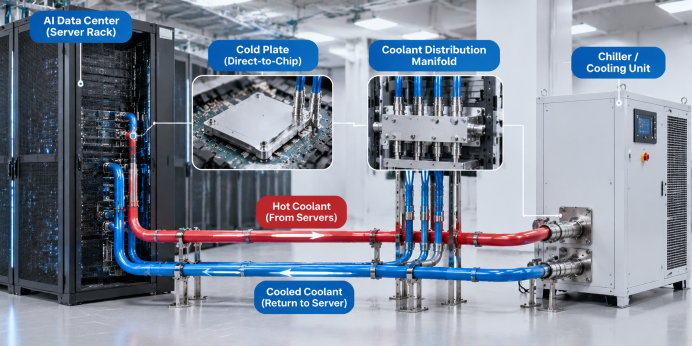
A liquid cooling system typically includes cold plates, coolant manifolds, pipes, hoses, quick disconnects (QDs), and coolant distribution units (CDUs). These components must provide reliable coolant circulation and stable heat transfer during operation.
However, particles left from machining, welding, assembly, or installation may enter liquid pathways. In components with narrow internal channels, contamination can contribute to flow restriction, filter loading, or reduced system reliability.
For manufacturers of liquid cooling components, liquid cooling component cleanliness testing helps evaluate particulate contamination before components are integrated into larger cooling systems.
Applicable Liquid Cooling Components
Cleanliness inspection may be required for components used in direct-to-chip liquid cooling systems and other liquid-cooled data center applications.
Typical components include:
l Cold plates
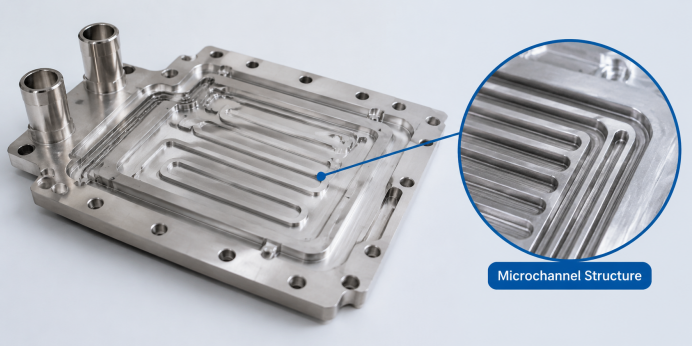
Internal microchannels and cooling passages used to transfer heat from processors and other electronic devices.
l Coolant manifolds
Distribution components that direct coolant to multiple cold plates or server nodes.
l Pipes and hoses
Fluid transportation components connecting cold plates, manifolds, and CDUs.
l Quick disconnects and fittings
Connection components used to install, maintain, or replace liquid cooling equipment.
l CDU-related fluid components
Selected valves, connectors, and fluid pathways within coolant distribution assemblies.
The inspection scope should be selected according to component design, wetted materials, internal geometry, and customer requirements. Particular attention may be needed for narrow channels, blind cavities, joints, and other areas where machining or assembly residues can remain.
Common Sources of Particle Contamination
Particle contamination can be introduced during several manufacturing and installation stages.
Machining and fabrication: Milling, drilling, cutting, grinding, and deburring may generate metal chips, burrs, and fine machining residues. These contaminants can remain inside cold plate channels, manifold passages, and connection ports.
Welding and joining: Welding residues, oxide particles, and other process debris may remain around joints or inside fluid pathways if post-process cleaning is insufficient.
Assembly and handling: Dust, fibers, wear debris, and particles from tools, fixtures, packaging, or the working environment may enter components during assembly and transportation.
Installation and commissioning: Construction debris, corrosion by-products, and dirt may enter system pipework during installation. OCP guidance on pre-commissioning cleaning highlights the importance of removing such contaminants before connecting pipework to liquid-cooled racks and CDUs.
For components with small internal passages, even a limited amount of residual contamination may require attention. The appropriate inspection and cleaning approach depends on the component structure and the customer's technical requirements.
Why Liquid Cooling Component Cleanliness Testing Is Necessary
In direct-to-chip cooling systems, coolant passes through carefully designed channels and connected fluid pathways. Particulate contamination may accumulate in filters, interfere with small passages, or contribute to operational problems.
For cold plate manufacturers, cleanliness inspection can help identify machining residues left inside cooling channels. For manifold and pipe manufacturers, it can support the evaluation of particles remaining after fabrication, welding, cleaning, and assembly.
A structured inspection process can help manufacturers:
l Evaluate particulate contamination on component surfaces and in accessible internal passages.
l Measure particle sizes and review particle distribution on an analysis membrane.
l Compare cleanliness results between production batches.
l Assess the effectiveness of cleaning and flushing processes.
l Provide inspection records for customer quality evaluation and supplier communication.
Applicable Cleanliness Testing Standards
Liquid cooling components used in AI data centers, such as cold plates, coolant pipes, manifolds, valves, and quick disconnect fittings, require effective control of residual particulate contamination to help maintain cooling system reliability and prevent potential flow restriction or blockage.
Although there is no single universal international standard defining particle cleanliness acceptance limits for all liquid cooling components, several established technical cleanliness standards can be used as references for component inspection, depending on the component type and customer requirements.
ISO 16232:2018 – Road Vehicles – Cleanliness of Components and Systems
ISO 16232:2018 specifies requirements for determining and documenting particulate contamination on functionally relevant components and systems. It provides a standardized framework for cleanliness inspection, including particle extraction, filtration, analysis, and reporting.
For liquid cooling applications, its inspection methods can be considered for components such as aluminum cold plates, coolant pipes, manifolds, valves, and connectors, particularly when manufacturers adopt automotive-style technical cleanliness requirements.
VDA 19.1 – Inspection of Technical Cleanliness
VDA 19.1 provides detailed methods and procedures for evaluating particulate contamination on functionally relevant components. It covers key aspects of technical cleanliness inspection, including contamination extraction, filter membrane analysis, particle measurement, and inspection result documentation.
These methods can be considered by liquid cooling component manufacturers to evaluate residual particles generated during machining, welding, assembly, and cleaning processes, subject to the applicable customer specifications.
For manufacturers of liquid cooling components, including cold plates, coolant manifolds, pipes, valves, and quick disconnect fittings, technical cleanliness inspection can help identify residual particles from manufacturing and assembly processes.
By applying appropriate technical cleanliness inspection methods and customer-specific acceptance criteria, liquid cooling component manufacturers can improve contamination control, verify cleaning effectiveness, and reduce the risk of particulate-related problems in cooling systems.
Cleanliness Testing Solutions
Jetblue CleanTec provides cleanliness extraction equipment and particle analysis systems for manufacturers of precision liquid cooling components. Equipment selection can be discussed according to sample geometry, material, internal structure, and customer inspection requirements.
Cleanliness extraction equipment
Extraction equipment helps remove particulate contaminants from component surfaces and accessible internal passages before filtration and analysis. Depending on the sample structure and testing requirements, suitable extraction methods may include pressure rinsing or ultrasonic extraction.
For cold plates, manifolds, pipes, and fittings, the extraction setup should consider the internal flow path and the areas where manufacturing residues may remain. The method should be selected to obtain representative samples without introducing additional contamination.
Particle analysis systems
After extraction and filtration, particles collected on the analysis membrane can be examined using an optical microscope and particle analysis system. The system can support membrane scanning, particle size measurement, particle classification according to configured inspection requirements, and automated report generation.
These results help quality teams review particulate contamination and maintain inspection records for production monitoring and customer communication.
Customized testing requirements
Liquid cooling components vary in material, geometry, channel design, and customer acceptance criteria. Jetblue CleanTec can discuss customized extraction and analysis configurations according to the component type and the inspection requirements provided by the customer.
CTA
Are you manufacturing cold plates, coolant manifolds, liquid cooling pipes, or quick disconnect components for AI data centers?
Jetblue CleanTec can help you evaluate suitable cleanliness extraction and particle analysis equipment according to your component structure and inspection requirements.
Contact us to discuss your liquid cooling samples, testing objectives, and customized cleanliness requirements.