Cleanliness Testing Solutions for Fuel & EV Automotive Components
Industry Overview: Why Component Cleanliness Matters
As fuel-powered and new energy vehicles continue to evolve, automotive components are becoming more integrated and precision-engineered. Fuel injection systems, hydraulic components, transmission parts, electric drive systems, and battery thermal management components all rely on reliable performance and controlled manufacturing quality.
During machining, assembly, cleaning, and handling, small particles can remain on component surfaces or inside internal passages. If these particles are not properly controlled, they may contribute to valve sticking, flow restriction, accelerated wear, or damage to sensitive functional surfaces.
For automotive manufacturers and suppliers, technical cleanliness testing is an important part of quality control. It helps identify particulate contamination, evaluate component cleanliness, and provide measurable information for production improvement and supplier quality management.
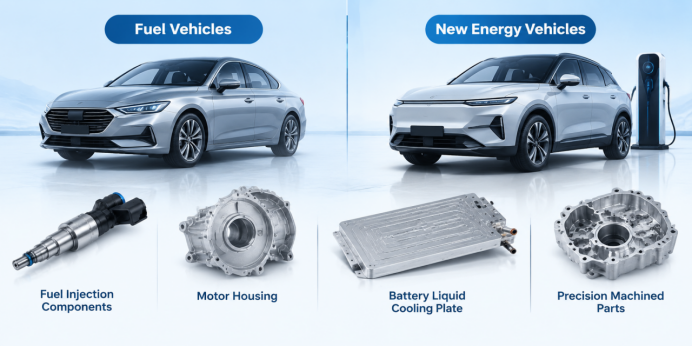
Applicable Automotive Components
Cleanliness inspection may be required for different functional components in fuel-powered and new energy vehicles. The actual inspection scope and acceptance limits should be determined according to component design, operating conditions, and customer requirements.
Fuel automotive components
l Fuel injectors, fuel pumps, and fuel rails
l Engine blocks, cylinder heads, and oil passages
l Transmission housings, gears, and hydraulic valve bodies
l Brake system components and precision hydraulic parts
EV automotive components
l Electric motor housings and drive system components
l Battery cooling plates and liquid-cooling manifolds
l Coolant pipes, connectors, and fluid control components
l Precision-machined parts used in battery and thermal management systems
For parts with narrow channels, blind holes, complex cavities, or internal flow paths, cleanliness inspection can help assess particulate contamination in areas that are difficult to evaluate through visual inspection alone.
Common Sources of Particle Contamination
Particle contamination can be introduced at multiple stages of automotive manufacturing. Identifying possible sources is essential for improving cleaning processes and reducing the risk of recurring defects.
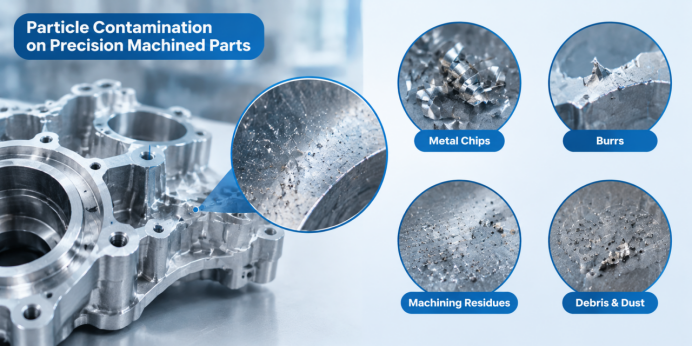
Machining and manufacturing: Turning, milling, drilling, grinding, and deburring may generate metal chips, burrs, and fine machining residues. These particles can remain in threaded holes, grooves, and internal channels.
Casting and forming: Sand residues, casting debris, oxide particles, and surface residues may remain after casting, forging, or other forming processes if cleaning is insufficient.
Cleaning and surface treatment: Inappropriate cleaning parameters, incomplete rinsing, or residue from cleaning media may leave particles or deposits on component surfaces.
Assembly and handling: Dust, fibers, wear debris, and particles from tools, fixtures, packaging, or the working environment may be introduced after cleaning.
For components with complex internal structures, contamination may be difficult to detect without a suitable extraction method. The inspection method should therefore be selected according to the component's material, geometry, and manufacturing process.
Why Automotive Component Cleanliness Testing Is Necessary
Particle contamination is not simply a surface appearance issue. In functional automotive components, particles may affect the performance and reliability of systems that depend on precise movement, controlled flow, or close-fitting surfaces.
For example, particles in fuel system components may interfere with small passages or precision valve structures. In hydraulic and transmission components, contamination may contribute to wear or affect the movement of sensitive parts. In electric vehicle thermal management systems, particles inside cooling channels may restrict flow or create additional risks for system operation.
A structured cleanliness inspection provides manufacturers with useful data to:
l Evaluate particulate contamination on or inside components.
l Measure particle size and particle distribution on an analysis filter.
l Compare inspection results between production batches or process conditions.
l Check the effectiveness of cleaning processes.
l Support supplier quality evaluation and manufacturing process improvement.
Cleanliness testing does not replace functional testing or durability testing. Instead, it provides additional evidence for controlling particulate contamination as part of an overall quality management process.
Applicable Cleanliness Testing Standards
For functionally relevant components in road vehicles, two important references are ISO 16232 and VDA 19.1.
ISO 16232:2018 – Road vehicles – Cleanliness of components and systems specifies requirements for applying and documenting methods used to determine particulate contamination on functionally relevant road vehicle components and systems. It supports initial evaluation, incoming and outgoing inspection, and quality control of cleanliness-related manufacturing processes.
VDA 19.1 – Inspection of Technical Cleanliness provides guidance for determining and documenting particulate contamination on functionally relevant automotive components. The third revised edition was published in February 2026.
These references help improve the consistency and comparability of cleanliness inspection results. However, they do not establish one universal particle limit for every automotive component. Acceptance limits and inspection conditions should be agreed upon by the customer and supplier based on the component's function and application.
For new energy vehicle parts, the applicable inspection requirements should also be confirmed with the customer. A battery cooling plate or electric drive component may be evaluated under automotive technical cleanliness requirements when it falls within the relevant scope and the customer specifies those requirements.
Cleanliness Testing Solutions
Jetblue CleanTec provides cleanliness extraction equipment and particle analysis systems for automotive component inspection. The equipment configuration can be selected according to component geometry, material, contamination characteristics, and customer testing requirements.
Cleanliness extraction equipment
Extraction equipment is used to remove particulate contaminants from component surfaces and accessible internal areas before filtration and analysis. Depending on the sample and test requirements, suitable extraction methods may include pressure rinsing or ultrasonic extraction.
For components such as fuel system parts, valve bodies, cooling plates, and fluid channels, the extraction setup should be selected to reach the relevant areas while avoiding unnecessary interference with the sample or test results.
Particle analysis systems
After extraction and filtration, the collected particles on the analysis membrane can be examined using an optical microscope and particle analysis system. The system can support particle scanning, size measurement, classification according to the configured inspection requirements, and inspection report generation.
This helps quality teams review particle contamination more consistently and retain inspection records for process monitoring and supplier communication.
Customized testing requirements
Different automotive components may require different extraction methods, filter specifications, analysis parameters, and reporting formats. Jetblue can discuss customized equipment configurations and testing standards according to the customer's component type and inspection requirements.
CTA
Looking for a suitable cleanliness testing solution for fuel system parts, precision hydraulic components, electric drive systems, or battery cooling components?
Jetblue CleanTec can help you evaluate suitable extraction and particle analysis equipment according to your sample characteristics and inspection requirements.
Contact us to discuss your component type, testing objectives, and applicable cleanliness requirements.